
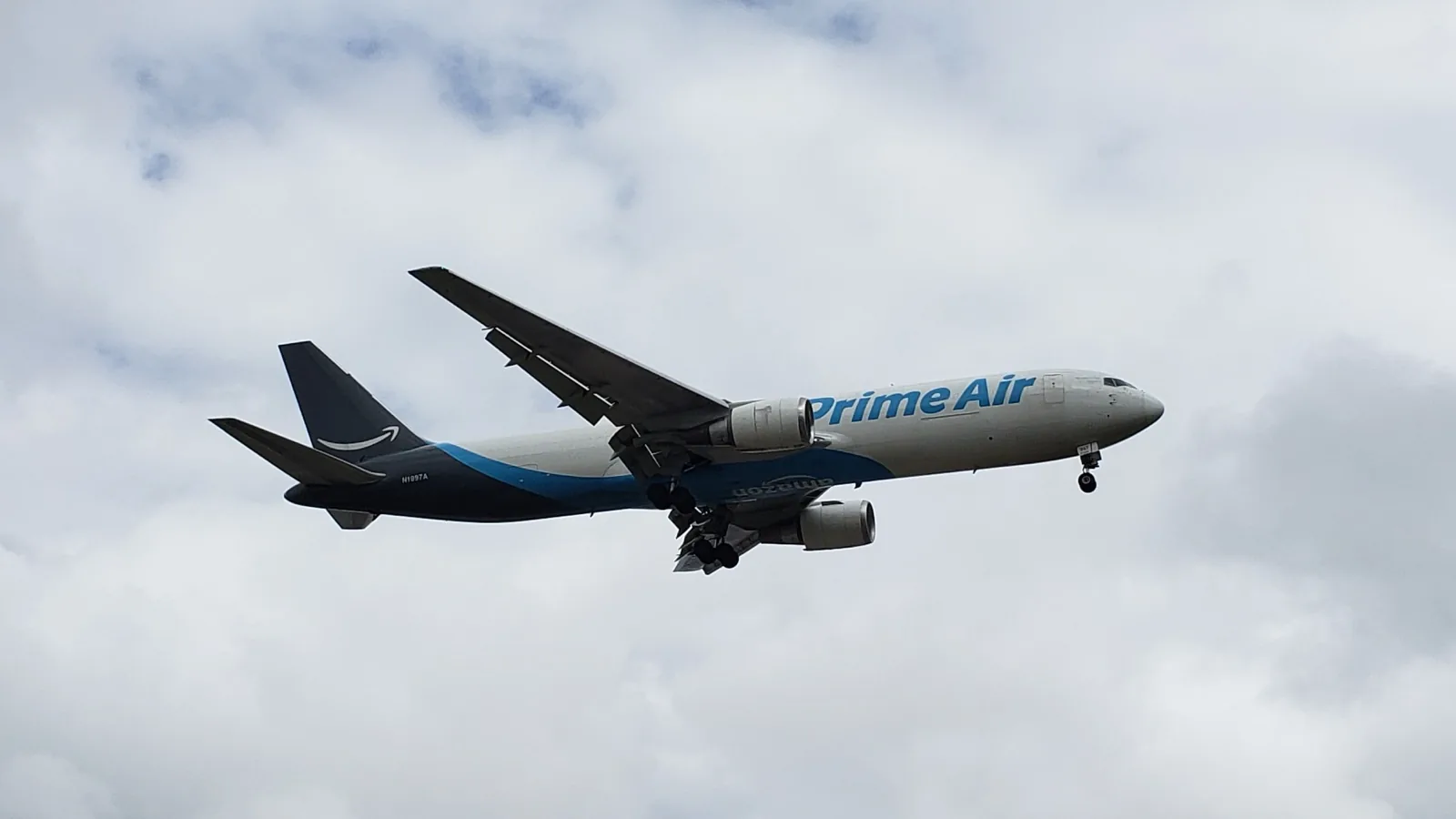
On Sunday afternoon, September 6, a Boeing 767 freighter flying for Amazon landed on runway 30 at Miami International Airport, did not stop, and left the far end of the pavement at 112 knots, about 130 miles an hour. It went through the airport’s perimeter fence and across a public road. On the way it hit a van carrying seven aircraft-cleaning workers inside the fence, and an SUV on NW 67th Avenue outside it. Five people in those two vehicles were killed and three more in them were critically injured. The two pilots survived with lesser injuries.
The flight was 21 Air 7598, callsign CSB7598, a scheduled cargo run up from San Juan, Puerto Rico, flown by 21 Air on behalf of Amazon Air. The airplane was N1997A, a 32-year-old 767-300 that spent its first two decades carrying passengers for five airlines on three continents and then, in 2016, became the first jet ever painted in Amazon’s colors.
This post is about what the public record shows so far, one day in: the recorded track, the weather, the runway, the airplane and the companies behind it. It is not about why. The National Transportation Safety Board has the flight recorders and 32 investigators on the ground, and the reason five people died will come from them, not from a flight tracker. Where we have numbers here they are measured ones, and where we don’t, we say so.
The last five minutes, replayed
This is the end of that flight as the ground receivers heard it: the last five minutes, from fourteen nautical miles out over the Atlantic to the moment the airplane left the runway. The positions, altitudes, speeds and headings are real, broadcast by the aircraft itself over ADS-B, picked up by ground receivers and published after the accident. Stowaway draws the world around them: the light, the coastline, the airport, from the seat. Press play. You can look around while it runs, and drag the timeline to any second of it.
Descent into Miami
The last five minutes of a Boeing 767 freighter's run up from San Juan — short final at Miami, touchdown, and along the runway to the moment it ran off the end.
Two things before you press play. The clouds are the app’s own; nobody recorded the sky over Miami that afternoon, and the real one had a thunderstorm in it. And the replay ends where the recording does. The feed carries on for nineteen seconds after the airplane leaves the pavement, and its last three positions lie past where the NTSB says it stopped, each reporting the same 69 knots. A slow airplane on the ground beyond a runway is the hardest thing in the whole track for a receiver to place. The replay shows an airplane leaving a runway. It does not show what happened after that, and nothing in it depicts the vehicles or the people who were in them.
What the track shows
Here is the same track in numbers, read off the fixes the replay plays. Times are Miami’s.
- 1:48:51 p.m. Fourteen nautical miles out at 4,600 feet, lined up on runway 30’s centerline. 229 knots over the ground.
- 1:51:31 p.m. Four miles out at 1,550 feet, 180 knots. It held close to that speed the rest of the way in.
- 1:52:52 p.m. Over the start of the pavement at about 175 feet, doing 178 knots over the ground. Runway 30’s landing threshold is displaced 945 feet up the runway; crossing it, the airplane was at about 120 feet. A landing is planned around crossing the threshold at 50.
- 1:53:03 to 1:53:08 p.m. Wheels on, somewhere in here. ADS-B altitude comes in 25-foot steps. The feed reads 25 feet from 1:53:03, touches zero at 1:53:08, and reads 25 again for the whole rollout, so the fixes can only bracket the touchdown: between 2,600 and 3,900 feet past the displaced threshold, and between 167 and 159 knots. Take the later reading and that is roughly halfway down the runway, with 4,550 feet of pavement left.
- 1:53:27 p.m. Off the end of the runway at 112 knots.
Two numbers carry most of the story. The first is where it touched down. The fixes put it between 2,600 and 3,900 feet past the threshold, The Aviation Herald reads the same data as 4,000, and the touchdown zone a crew aims for is the first 3,000. From the start of the pavement to the later of those readings took sixteen seconds and 4,800 feet, the “float” that analysts who have watched the videos describe. Mary Schiavo, the former Transportation Department inspector general, told the AP the airplane “lost a lot of critical real estate by just continuing to float over the runway.” The second number is how fast it was still going with half a runway left. From 159 knots at the later reading to 112 at the end is a deceleration of about two and a half knots per second. Stopping in the 4,550 feet that remained would have taken roughly twice that.
ADS-B reports speed over the ground, not airspeed, and the wind was behind the airplane, so the flight data recorder’s numbers are the ones that matter. But 178 knots over the ground on short final is fast for a 767, which typically crosses the threshold somewhere in the 140s.
Videos circulating since Sunday appear to show the airplane touching down on one main gear before the other, and one close reading of them, by the Aviation Law Group, notes that they do not appear to show the thrust reversers opening or the wing spoilers rising. Whether that is so, and why, is exactly what the recorders and the wreckage will establish. On a 767 the automatic spoilers wait for both main gear trucks to settle onto the pavement with both thrust levers at idle, and the reversers are locked out until the airplane’s air-ground logic agrees it has landed; pulling reverse also brings the spoilers up, so on a rollout the two tend to appear together or not at all. That describes the design. It says nothing yet about this flight.
The weather
Miami’s 1:53 p.m. observation, taken as the airplane was rolling: wind from 190° at 17 knots gusting to 26, a thunderstorm on the field, cumulonimbus at 2,000 feet, lightning to the east and south. The storm had started at 1:12, and there had been a wind shift at 1:37. The peak gust, 26 knots from 180°, was logged at 1:52, a minute before touchdown. An hour earlier the wind had been five knots. An hour later it was calm.
Runway 30 points at 299° true. A wind from 180 to 190° is mostly across it from the left, with a component from behind: around five knots in the steady wind, and roughly ten to thirteen in the peak gust. Boeing’s standard tailwind limit for landing the 767 is ten knots. A tailwind adds to landing distance (the FAA’s rule of thumb is about 21 percent for every ten knots), and a gust front arriving during the flare is the kind of thing that turns a stable approach into a long one. What the wind actually did over the runway, second by second, is on the recorder, and what the crew were told and expected is on the tower tapes. The NTSB has both.
The Aviation Herald cites a NOTAM taking runway 30’s PAPI out of service, and it has been reported as though it belonged on that list. The PAPI is the row of red-and-white lights beside the runway that tells a pilot whether they are on the right glidepath. The NOTAM’s effective time is 3:54 p.m., two hours after the landing, and it is the first of four notices issued within six minutes of each other: the runway 12 approach lights, then the closure of runway 30, then of 26L. That is an airport recording the state of its field after an accident. Nothing in the record says the lights were out during the approach, and whether they were is the NTSB’s to say.
The runway
Runway 12/30 is Miami’s crosswind runway: 9,360 feet of grooved asphalt, against 13,016 for runway 9/27 next door. Landing on 30, the first 945 feet are displaced threshold, pavement you may roll on but not land on, and the FAA’s published landing distance for the runway is 7,913 feet, which stops about 500 feet short of the far end of the pavement. Beyond the far end is the 1,000-foot runway safety area the FAA’s design standard calls for, then a perimeter service road, the fence, and NW 67th Avenue, a public street with traffic on it. The NTSB says the airplane came to rest about 1,300 feet past the paved surface.
Miami has no EMAS, the bed of crushable concrete that sits past the end of some runways and stops a jet the way a gravel escape lane stops a truck. It is not required to have one: an airport with a full-length safety area meets the standard. NTSB Chair Jennifer Homendy said on Monday that the board would look at whether one should have been there and whether it would have made a difference. The closest precedent is Chicago Midway in December 2005, when a Southwest 737 went through the fence onto Central Avenue and killed a six-year-old boy in a car. Midway has EMAS beds at its runway ends now.
The airplane: Amazon One
N1997A was thirty-two years old, and it had an unusually well-documented life, because for most of it it was somebody’s photograph.
Boeing built it as the 545th 767, a 767-33A(ER), the “3A” in the type being Boeing’s customer code for AWAS, the leasing company that ordered it. First flight: June 17, 1994. A week later it was delivered to Sobelair, the charter subsidiary of Belgium’s national airline Sabena, as OO-SBY. Sobelair had leased a 767-300ER to relaunch its long-haul holiday flying, and this was it.
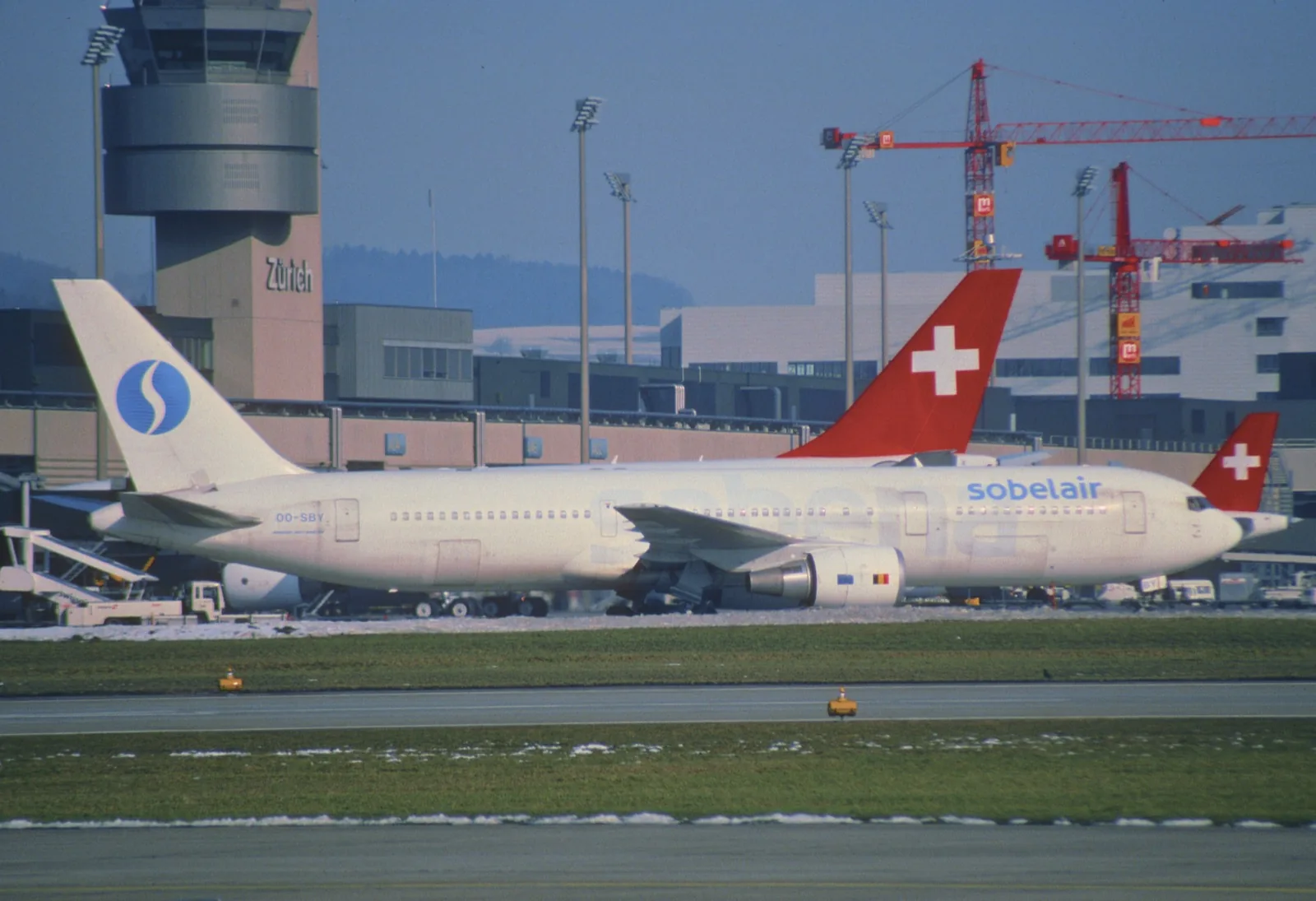
OO-SBY at Zurich in February 1999, in its fifth year. Sobelair went bankrupt in January 2004, two years after Sabena did. Photo: Aero Icarus, CC BY-SA 2.0.
From November 2000 it flew for Vietnam Airlines as VN-A768, and from July 2003 for Spain’s Air Europa as EC-IQA.
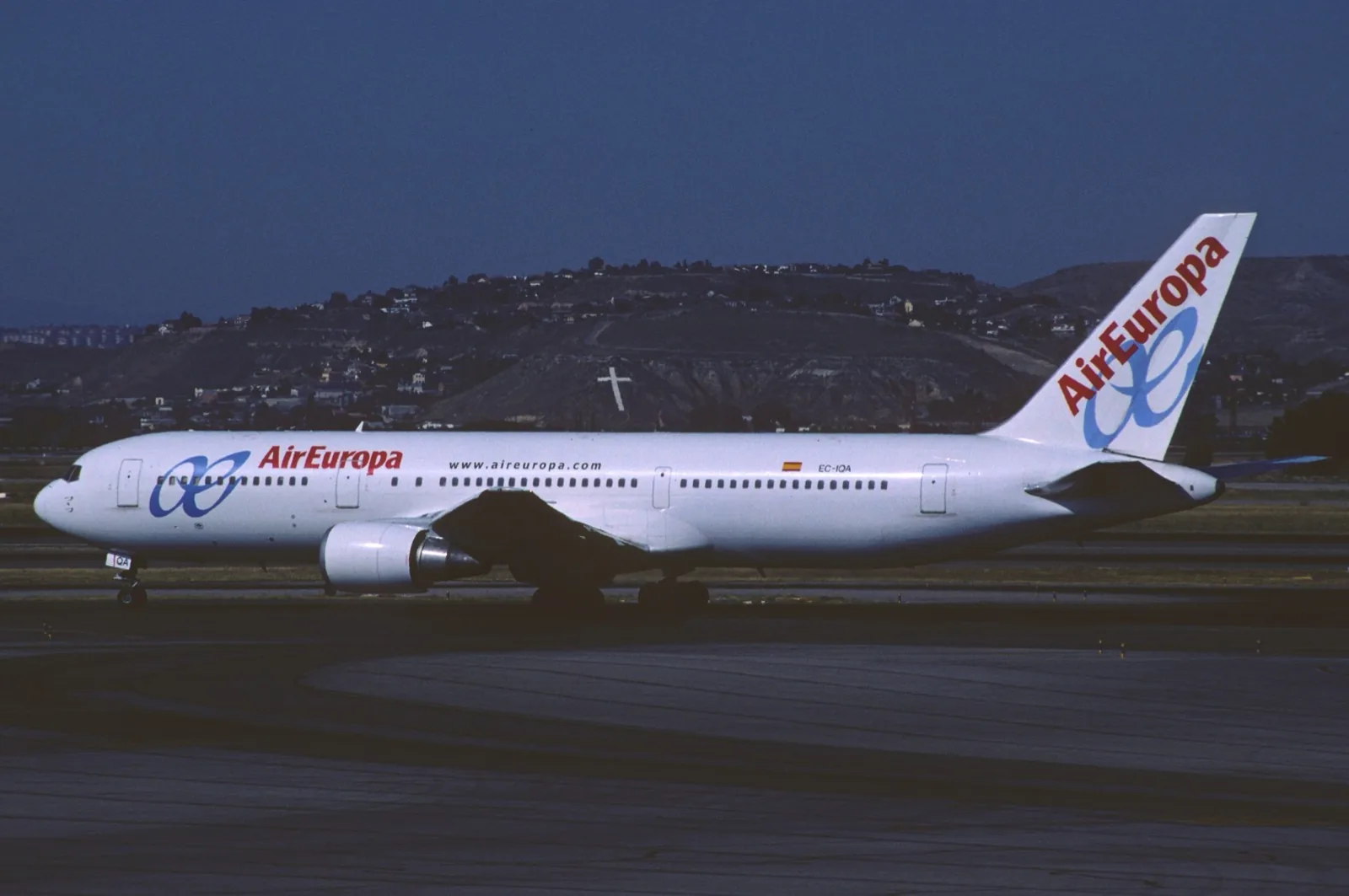
EC-IQA at Madrid-Barajas in August 2005. Photo: Aero Icarus, CC BY-SA 2.0.
In July 2006 it went to Kenya Airways as 5Y-KQQ, “The Pride of Africa” lettered under the cockpit windows, and flew out of Nairobi for four years before going into storage in May 2010.
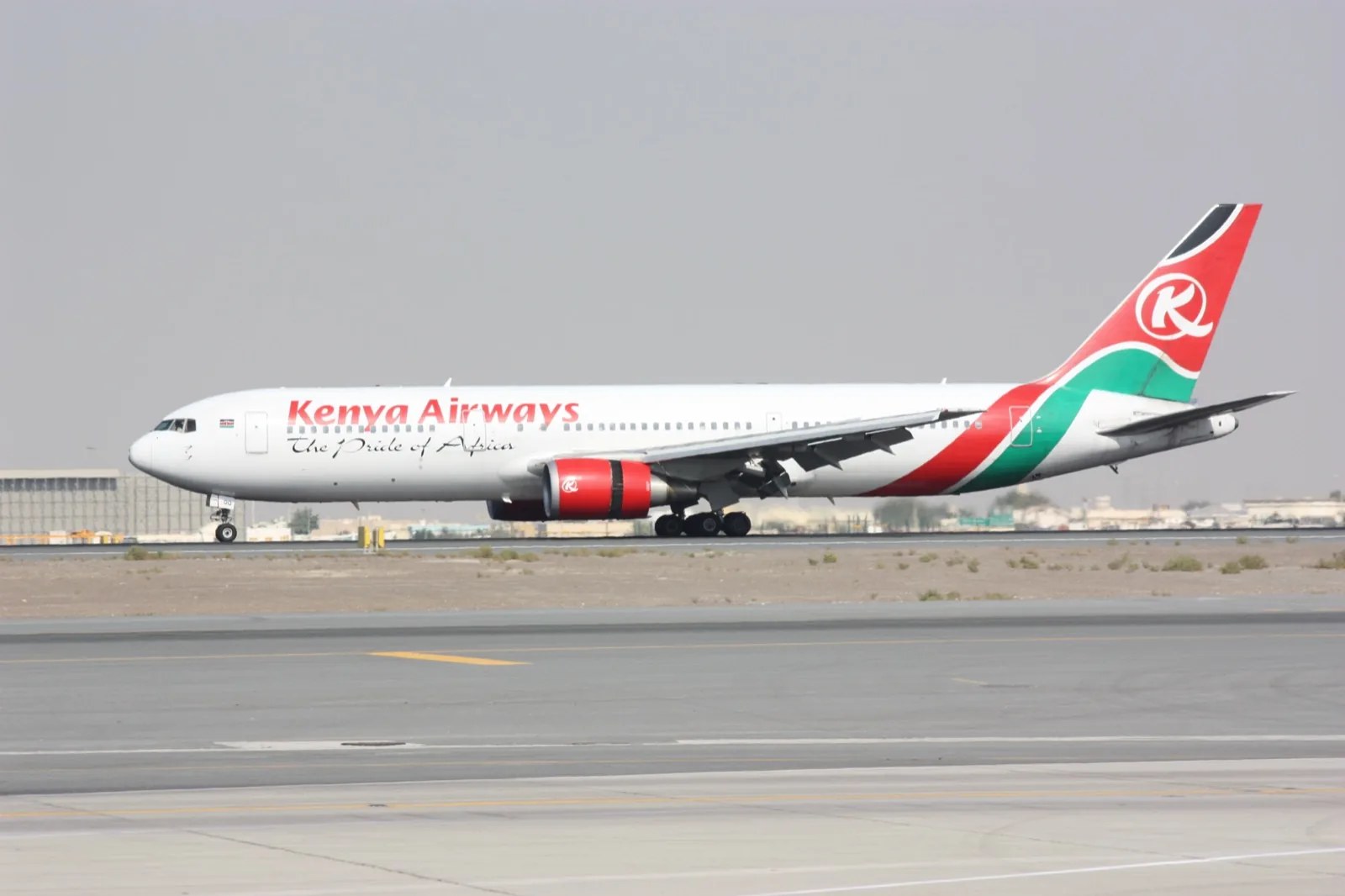
5Y-KQQ at Dubai in November 2009. Photo: Pete Macklin, CC BY-SA 2.0.
Five months later it was flying Russian holidaymakers to the sun for Nordwind Airlines as VQ-BRA, which is how it came to be photographed under tow at Bangkok in 2014.
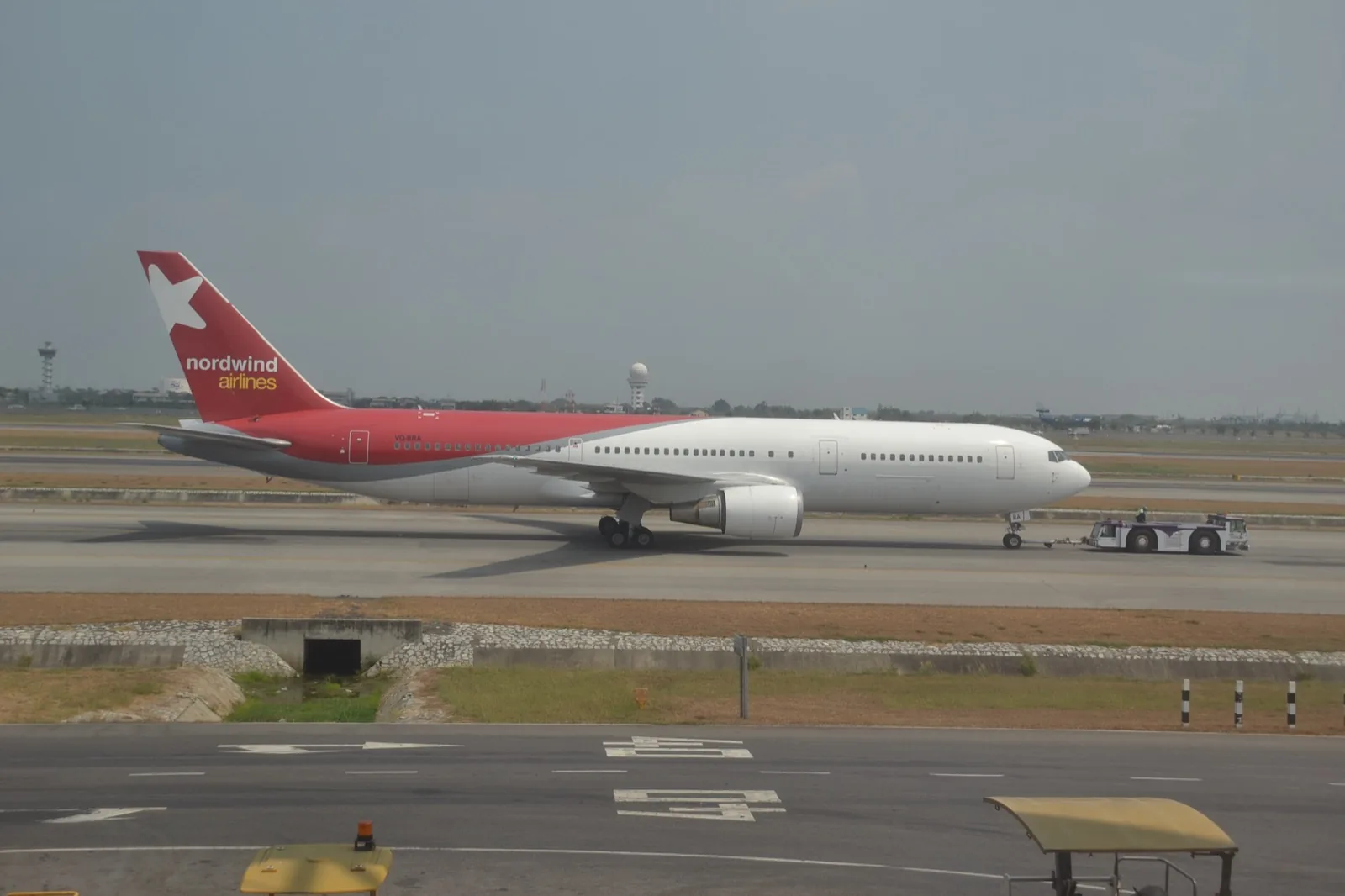
VQ-BRA at Bangkok in March 2014, twenty years old and about to get a second career. Photo: Alec Wilson, CC BY-SA 2.0.
That was the end of its passenger life. Nordwind gave it back in December 2014, and in September 2015 Atlas Air took it, as N648GT for the moment, and flew it to Israel Aerospace Industries’ Bedek division in Tel Aviv, which cut a cargo door into the forward fuselage, stripped out the cabin and strengthened the floor: a “BDSF,” Bedek Special Freighter. It came out of the hangar in June 2016 with a job waiting. Amazon had announced a cargo airline of its own the previous December, and in May 2016 Atlas Air signed on to fly twenty 767s for it. The first airplane to wear the livery was this one, and Amazon gave it a name and a registration to match: Amazon One, N1997A. The registration was a joke for the initiated, since 1997 is a prime number and the year Amazon went public. It was unveiled over Lake Washington on August 5, 2016, the Friday of Seattle’s Seafair weekend, a blue-and-white 767 with a smile on its tail, flying past the crowds on the shore.
For the next eight years it flew Amazon’s network as an Atlas Air airplane. In January 2025 it moved, paint unchanged, to 21 Air’s operating certificate, one of seven 767s that carrier took on as Amazon shifted flying away from Atlas. The owner of record on the day of the accident was Andromeda Leasing II LLC, an Atlas-affiliated leasing entity. It had two General Electric CF6-80C2 engines and a crew of two.
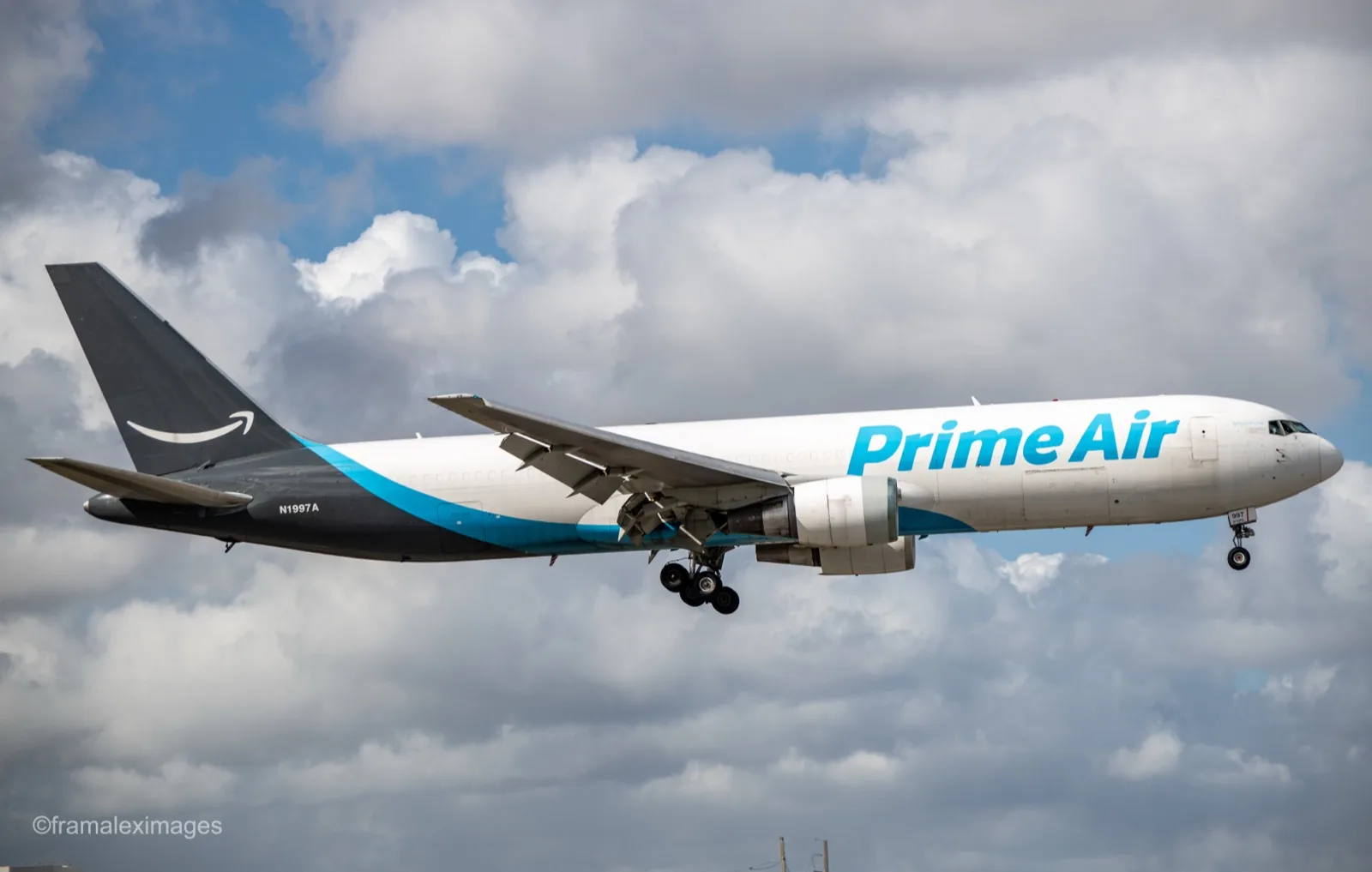
N1997A on short final into Miami in March 2026, six months before the accident. The photograph at the top of this post is the same airplane on approach to Miami in December 2025. Photo: framalex images, CC BY 4.0.
21 Air
21 Air is not a name most people had heard before Sunday, which is more or less the point of it: it flies other companies’ airplanes under other companies’ brands. Adolfo Moreno, a former Miami air-cargo broker, founded it in February 2014 as a “virtual” airline flying under another carrier’s certificate, and it got its own in the summer of 2016 with a pair of 767-200 freighters. The headquarters are in Greensboro, North Carolina, with operating bases at Piedmont Triad and Miami, and the DHL flying began in 2020. In 2021 Jim Crane, the Houston Astros owner and a former chairman of the Canadian cargo airline Cargojet, bought control, with Cargojet taking a quarter of the company; Cargojet sold its stake this April. The chief executive, Tim Strauss, left when his contract ran out in February, and Crane put Keith Winters, who had run his logistics company, in charge on an interim basis.
The Amazon work began in November 2024, when 21 Air took on seven 767-300 freighters that Atlas had been flying for Amazon, N1997A among them. Its fleet is around twenty aircraft, the exact count depending on who is counting and when: 757s for DHL, a couple of 767-200s, and a dozen or so 767-300 freighters for Amazon, DHL and LATAM Cargo. Its ICAO code is CSB, which is why the callsign on your flight tracker read CSB7598 while the flight number was 2I7598.
Winters’s statement on Sunday: “We are devastated by the accident involving one of our aircraft in Miami today. Our deepest condolences are with the families and loved ones of those who lost their lives.” The company says it is cooperating fully with the NTSB, the FAA and local authorities.
Amazon Air
The words on the side of the airplane say Prime Air, and the FAA and the NTSB say 21 Air, and both are right. Amazon Air is a virtual airline. Amazon owns or leases the jets (about a hundred of them, most of them 767 freighters, with a hub at Cincinnati/Northern Kentucky) and contracts carriers to fly them under CMI agreements: crew, maintenance and insurance. Atlas Air, ATSG’s Air Transport International and ABX Air, Sun Country, Hawaiian, Cargojet and, since 2024, 21 Air have all flown Amazon-branded airplanes, along with smaller partners in Europe and India. Amazon sets the network; the carrier’s name is on the operating certificate, and the carrier’s pilots are in the seats.
This is the second fatal accident of a flight operating for Amazon Air. On February 23, 2019, Atlas Air Flight 3591, another 767 freighter and also out of Miami, crashed into Trinity Bay on approach to Houston, killing the two pilots and a jumpseating pilot. The NTSB found the first officer had become disoriented after inadvertently triggering the go-around mode. Homendy said on Monday that the contractual relationship between Amazon and 21 Air is among the things this investigation will examine.
Amazon’s statement, from spokesperson Kelly Nantel: “We’re heartbroken to learn that five people lost their lives in today’s incident at Miami International Airport. Our deepest sympathies go out to the families, loved ones, and all those affected by this devastating loss.”
The people
Everyone who died on Sunday was on the ground. The van was a white Ford Econoline belonging to Professional Ocean Service Corp., a contractor that cleans aircraft cabins for airlines at Miami; there were seven people in it, on a service road inside the airport fence. The SUV was a Toyota Corolla Cross on NW 67th Avenue, outside the fence. The names of the dead had not been officially released as this was written; a vice president of the cleaning company confirmed that its employees were among them. The three most seriously injured are at Jackson Memorial’s Ryder Trauma Center. Miami-Dade Fire Rescue’s first unit was on scene within thirty seconds, and more than sixty followed.
The pilots were trapped in the cockpit at first. Video shows rescuers climbing a ladder to a cockpit window, and later a pilot jumping down from the airplane; a witness described one of them with cuts to the forehead and a hand. Both were taken to Jackson South. As of Monday, investigators had not yet interviewed them.
What happens now
The NTSB announced its go-team on Sunday afternoon and had it on the ground Monday. Homendy, walking the route that day, called it “utter devastation”: tire marks from the pavement into the grass, the navigational aids the airplane hit, the fence, the vehicles, debris everywhere. The flight data and cockpit voice recorders were recovered and flown to the NTSB’s laboratory in Washington. Homendy said more would follow on Tuesday, possibly including a speed confirmed by the recorder; she has numbers from other sources and wants the recorder’s before she says one. Investigators will be on site for at least a week, documenting the wreckage once the fuel is off it. A preliminary report, facts only, typically follows within thirty days, and the final report with a probable cause takes a year or more. The working groups are operations and human performance, aircraft systems and structures, aircraft performance, powerplants, air traffic control, meteorology, and airport and survival factors, plus, as Homendy said, the relationship between Amazon and its operator and the question of the arrestor bed.
Anyone who saw the accident or has photographs or video of it can send them to witness@ntsb.gov.
We’ll update this post as the NTSB releases what it finds. The replay will stay as it is: it is what the receivers heard, and only the investigation can add to it.
Sources & further reading: FAA statement · NTSB Newsroom · The Aviation Herald · Aviation Safety Network · PBS NewsHour on the NTSB briefing · CNBC · CBS Miami · NBC News on the victims · FreightWaves · AeroTime · Aviation Law Group: what we know so far · Wikipedia: 21 Air Flight 7598 · Wikipedia: 21 Air · Wikipedia: Amazon Air · Seattle Times on Amazon One, 2016 · AirNav: KMIA
Photos, all via Wikimedia Commons: N1997A on approach to Miami, December 2025 by Hector Ossa J., CC BY 4.0 · N1997A at Miami, March 2026 by framalex images, CC BY 4.0 · OO-SBY at Zurich, 1999 and EC-IQA at Madrid, 2005 by Aero Icarus, CC BY-SA 2.0 · 5Y-KQQ at Dubai, 2009 by Pete Macklin, CC BY-SA 2.0 · VQ-BRA at Bangkok, 2014 by Alec Wilson, CC BY-SA 2.0. Track data: ADS-B ground receivers. The airframe’s dates are from the photographers’ own records against its construction number, 27310.